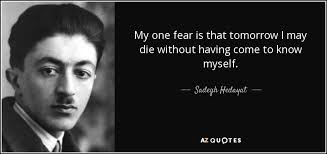

I. Life of Sadeq Hedayat
Early Life
- Born: February 17, 1903, Tehran, Iran
- Family: Aristocratic background; his father was a prince of the Qajar dynasty and held high administrative positions.
- Hedayat had access to the best educational institutions of his time and was part of Iran’s cultural elite.
Education
- Attended Darolfonoon, a prestigious modern school in Tehran.
- In 1925, he was sent by the Iranian government to Europe (Belgium and later France) to study.
- Initially intended to study engineering, he abandoned it and developed a deep interest in literature, philosophy, and mysticism.
Struggles in Europe
- Suffered from severe depression.
- Attempted suicide by throwing himself into the Marne River in France (unsuccessful).
- Became deeply influenced by Western philosophy, especially Schopenhauer, Nietzsche, Kafka, and Buddhism.
Return to Iran
- Returned to Iran in 1930.
- Became part of the intellectual avant-garde in Tehran.
- Worked for the Bank Melli Iran and later the Ministry of Culture.
Later Years and Death
- Left Iran for Paris in 1950.
- Lived in self-imposed exile, struggling with existential despair and disillusionment.
- Committed suicide on April 9, 1951 in Paris by gassing himself in a rented apartment. He was 48.
- Buried at Père Lachaise Cemetery in Paris.
II. Literary Works
Hedayat’s work is deeply psychological, philosophical, and often grotesque. He is known for introducing modernism and literary realism into Persian literature.
1. The Blind Owl (بوف کور) – 1937
- His masterpiece and most famous work.
- Written in Persian, first published in India due to censorship in Iran.
- A surrealistic, fragmented narrative told by an unreliable narrator.
- Themes: Death, madness, existential despair, alienation, decay, and time.
- It is often compared to Kafka’s works for its psychological depth and use of dream logic.
“There are sores which slowly erode the mind in solitude like a kind of canker.” — The Blind Owl
2. Three Drops of Blood (سه قطره خون) – 1932
- A collection of short stories.
- Experimental and macabre.
- Contains tales that touch on insanity, horror, social hypocrisy, and psychological torment.
3. The Stray Dog (سگ ولگرد) – 1942
- A symbolic story about a stray dog named “Pat”.
- The dog’s pain and isolation reflect Hedayat’s themes of abandonment and suffering.
- Strong empathy toward animals, perhaps mirroring his view of human cruelty and indifference.
4. Buried Alive (زندهبهگور) – 1930
- A short story collection.
- Features introspective, often nihilistic characters, dealing with depression and detachment.
- The title story is a symbolic reflection of mental suffocation and the need to escape.
5. The Message of Kafka (پیام کافکا) – 1948
- A critical essay exploring the philosophy of Franz Kafka.
- Reflects Hedayat’s admiration for Kafka’s existential and absurdist view of life.
III. Themes in Hedayat’s Work
- Existentialism and Absurdity
- Life as meaningless; the self as fragmented and disillusioned.
- Mental Illness and Alienation
- Protagonists often struggle with madness, suicidal thoughts, and paranoia.
- Critique of Religion and Tradition
- Sharp criticism of superstition, clerical hypocrisy, and cultural stagnation in Iran.
- Death and the Unconscious
- Death is omnipresent; Hedayat explores dreams, hallucinations, and the unconscious mind.
- Empathy for the Marginalized
- Sympathy for animals, the poor, and the mentally ill.
IV. Legacy
- Pioneer of Modern Persian Literature: His experimental narrative style influenced generations of Iranian writers.
- Censorship and Influence: Some of his work was banned in Iran for many years. Still, he remains a central figure in Iranian intellectual discourse.
- Global Reach: The Blind Owl has been translated into more than 30 languages and remains a cult classic in world literature.
- Cultural Icon: He represents the tragic artist-intellectual caught between tradition and modernity, East and West.
V. Notable Quotes
“I write only for my shadow which is cast on the wall in front of the lamp. I must introduce myself to it.” — The Blind Owl
“The thought of suicide is a great consolation: by means of it one gets through many a dark night.” — Echoing Schopenhauer